Kitchen deep cleaning in Newport News, Virginia

Restaurant Kitchen Deep Cleaning in Newport News

Remove baked-on grease, food residue, and floor buildup with a detailed cleaning plan fitted to your equipment, operating hours, and problem areas.

✓ Equipment-specific scope
✓ Planned around operations
✓ Floors and cooking areas
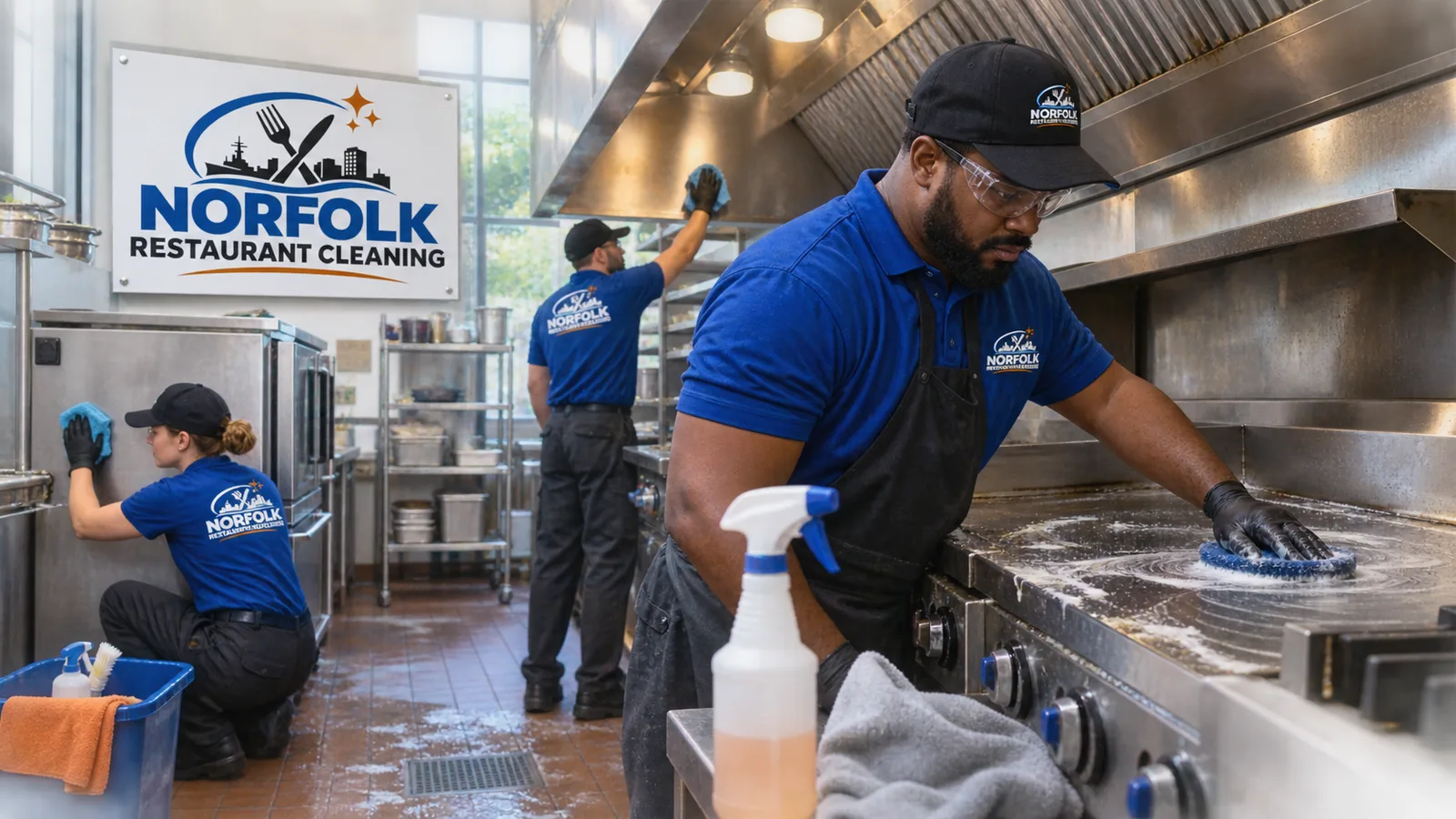
A professional crew deep cleaning stainless steel cooking equipment and surrounding surfaces in a Newport News commercial kitchen
Crew standard Ready
to open
Norfolk • VA

Built around the kitchen

Detailed Cleaning for Hard-Working Commercial Kitchens

Restaurant Kitchen Deep Cleaning Newport News work reaches the areas that routine closing duties cannot fully address. Aerosolized cooking oil settles on equipment sides, walls, shelving, pipes, and other exposed surfaces. Spills collect beneath movable units, while repeated traffic presses grease and food soil into grout lines and textured flooring. A planned deep clean removes that layered buildup without turning the job into a rushed wipe-down.

Norfolk Restaurant Cleaning develops the scope around the kitchen rather than applying a standard checklist to every property. From our base on Lyons Avenue, Norfolk's local restaurant service coordinates work with restaurant operators across the water in Newport News. Access through the Hampton Roads Bridge-Tunnel can affect crew movement, so arrival, equipment staging, and the order of work are settled before service begins. That preparation matters when a kitchen has a narrow cleaning window between closing and the next prep shift.

The scope can cover cooking-line exteriors, stainless steel surfaces, prep areas, walls, shelving, floor edges, drains, and reachable spaces beneath or behind equipment. We identify what can be moved safely, what must remain connected, and which surfaces require a gentler product. Exhaust-duct cleaning, fire-suppression work, pest control, and equipment repair require the appropriate specialist and are not treated as ordinary surface cleaning.

Request a Callback

Defined deep-clean scope

What a Restaurant Kitchen Deep Clean Can Cover

The final work order should name the surfaces and equipment included. Common targets are range and fryer exteriors, flat-top surrounds, backsplash panels, prep tables, sinks, shelving, kick plates, casters, wall-floor junctions, and the accessible floor beneath movable equipment. Detachable components may be soaked or cleaned separately when their material and the manufacturer's instructions allow it.

Degreasing starts with dwell time. A suitable product must remain on the soil long enough to loosen it before agitation and removal. Scrapers, non-scratch pads, brushes, microfiber cloths, and controlled rinsing are selected for the surface. Stainless steel needs different handling than painted walls, aluminum components, quarry tile, or resilient flooring. Food-contact surfaces are rinsed as required and receive an appropriate food-contact sanitizer after cleaning. Cleaning removes soil; sanitizing is a separate step performed on an already clean surface.

Heavy deposits are often reduced in stages. Applying excessive chemical strength or aggressive abrasion can haze metal, damage coatings, or drive dirty liquid into electrical parts. Crews also protect pilot areas, controls, outlets, and equipment openings from uncontrolled moisture. The aim is thorough soil removal with sensible protection for the kitchen's working assets.

Request a Callback
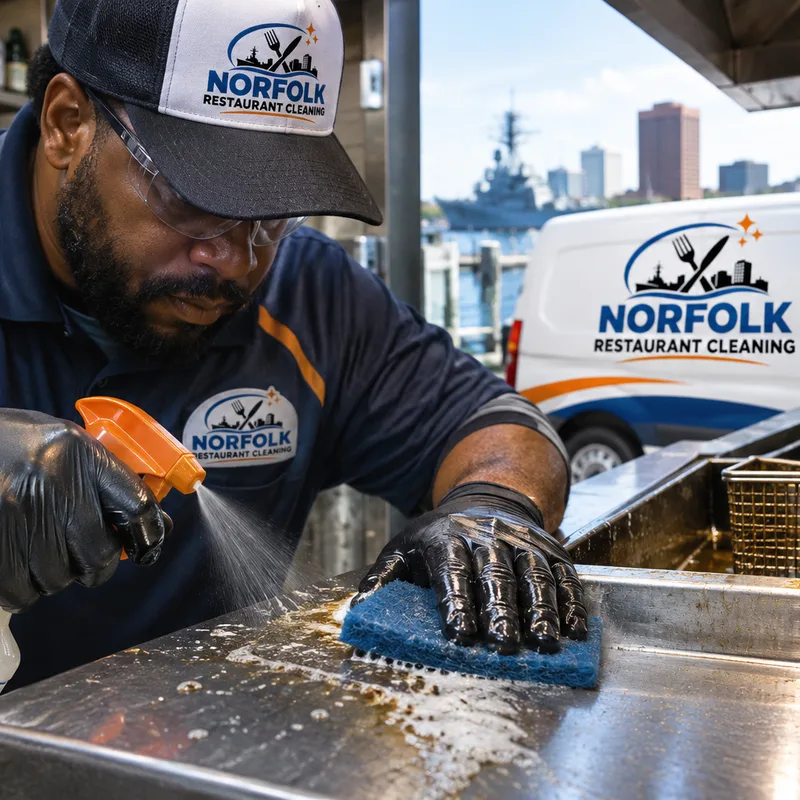
Close view of a technician using a non-scratch pad and controlled degreaser application on greasy stainless steel beside a commercial fryer
Surface-specific tools help remove grease without careless abrasion.

Kitchen zones that need detail

Priority Areas in a Newport News Restaurant Kitchen

Cooking-Line Buildup

Fryers, ranges, flat tops, and nearby panels collect carbonized food soil and airborne oil. The scope identifies accessible exteriors, removable parts, seams, legs, and casters that can be cleaned without disconnecting regulated utilities.

Equipment Gaps and Edges

Grease and debris often remain along kick plates, wall junctions, pipe penetrations, and beneath equipment. These spaces require narrow brushes, scraping, or careful repositioning rather than a quick mop pass.

Prep and Wash Areas

Sinks, tables, shelving, splash zones, and washable walls can develop food film and mineral residue. Products are chosen according to the deposit and the surface, with food-contact areas handled separately.

Floors, Grout, and Drains

Restaurant Floor Cleaning Newport News service addresses greasy traffic lanes, grout lines, corners, and reachable drain surrounds. Soil is agitated and recovered so it is not simply spread across the floor.

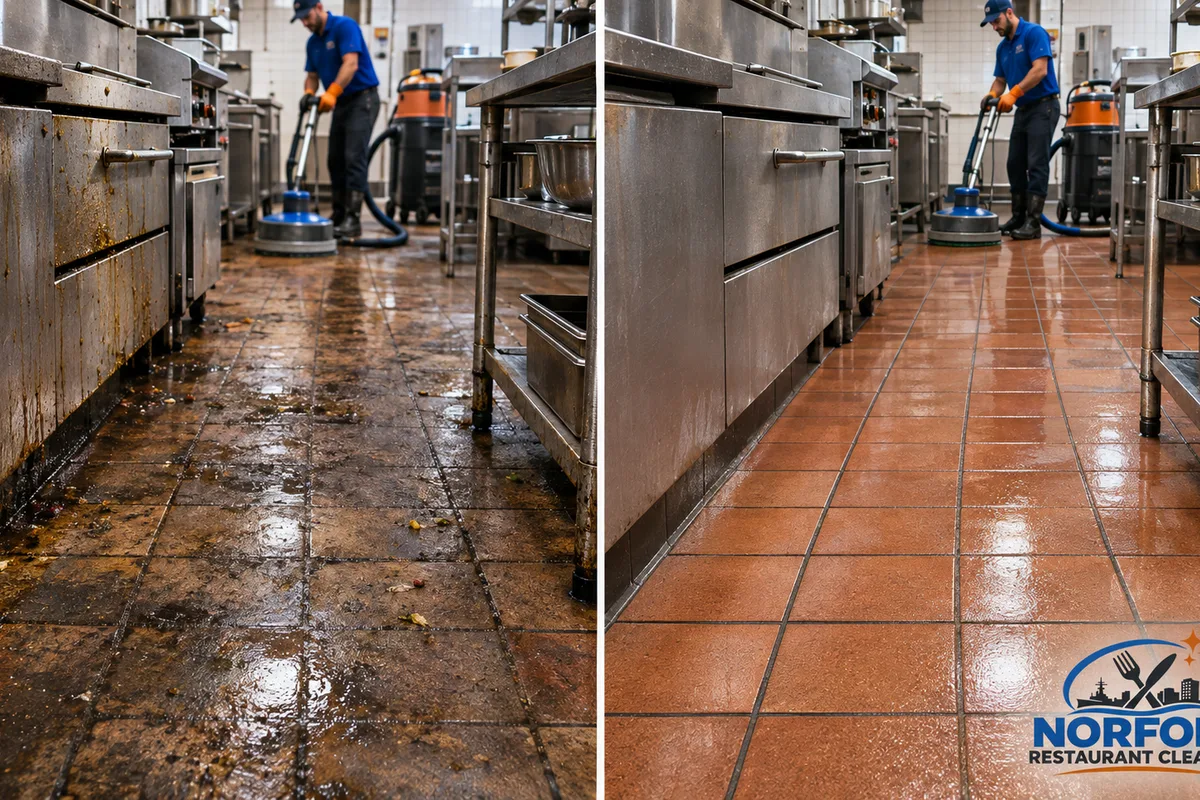
A side-by-side view of a greasy commercial kitchen tile floor and the same floor after machine agitation, slurry recovery, and edge cleaning
Proper recovery removes loosened soil instead of redistributing it.

Controlled floor care

Restaurant Floor Cleaning in Newport News

Commercial kitchen floors need more than stronger mop solution. Grease can lodge in grout joints, textured tile, low spots, and the perimeter beneath cooking equipment. A useful floor-care plan begins with dry debris removal, degreaser application, proper dwell time, and mechanical agitation suited to the floor. The slurry is then extracted or recovered, followed by controlled rinsing and drying.

Quarry tile and cementitious grout are common commercial-kitchen materials, but the actual floor must be identified before work starts. A method appropriate for tile may be wrong for sheet vinyl, epoxy, or another resinous system. Excess water can also migrate under equipment or into damaged joints, so pressure and liquid volume must be controlled. Floor drains are kept open for normal flow, but drain-line blockages and plumbing faults need a licensed plumbing professional.

Newport News contains dining operations in distinct settings. City Center at Oyster Point has restaurants in mixed-use commercial properties where loading access and building rules may shape the schedule. Port Warwick businesses often work around neighboring tenants and customer traffic. Restaurants near the Jefferson Avenue corridor may have busy vehicle access and tightly timed deliveries. In each setting, the practical questions are the same: where the crew can stage, when equipment can cool, and how much drying time is available before employees return.

Request a Callback

From scope to final review

How the Deep-Cleaning Process Works

  1. Step 1 of 5

    Define the Scope

    We review the cooking line, prep zones, floors, access points, sensitive equipment, and the condition of major surfaces. The written scope identifies included areas, exclusions, and any preparation expected from restaurant staff.

  2. Step 2 of 5

    Plan Around Operations

    Service is scheduled after equipment has been shut down and cooled. The plan accounts for closing duties, food storage, alarm or access procedures, crew staging, and the time needed for surfaces and floors to dry.

  3. Step 3 of 5

    Protect and Prepare

    Exposed food and portable utensils must be removed or securely protected. Crews perform dry soil removal, isolate sensitive controls and openings, set up tools, and move only equipment that can be repositioned safely.

  4. Step 4 of 5

    Degrease and Detail

    Approved products are applied with the correct dwell time, then deposits are agitated and removed. Detailed work proceeds through the agreed equipment, walls, shelving, edges, and floor zones in a controlled order.

  5. Step 5 of 5

    Rinse, Sanitize, and Review

    Residue is removed, food-contact surfaces are treated appropriately, and wastewater is managed according to the property's approved arrangements. The crew reviews the completed scope and notes any damage or maintenance issue discovered during access.

Clear responsibilities and timing

A Scope Built for Your Equipment and Cleaning Window

A useful proposal is specific. It should state which equipment exteriors, walls, floors, drains, shelves, and hard-to-reach areas are included. It should also explain whether the restaurant must empty shelves, remove food, shut down appliances, or arrange access through property management. If equipment cannot be moved because of gas, electrical, plumbing, weight, or warranty restrictions, cleaning is limited to safely reachable surfaces unless an authorized trade disconnects it.

Frequency depends on cooking volume, menu, ventilation performance, staffing routines, and the amount of frying or high-heat cooking. Some operators schedule recurring detail work for the cooking line and floors, then use a larger periodic scope for less accessible areas. Others book a deep clean before reopening, after equipment changes, or when routine cleaning is no longer removing the film. The right interval is based on observed buildup rather than a generic calendar.

Professional cleaning supports a more orderly workspace, but it does not replace daily sanitation procedures or regulatory oversight. Restaurants in Newport News operate under Virginia food-safety requirements and local inspection authority. Managers remain responsible for their approved food-safety practices, chemical labeling, equipment maintenance, and any corrective action required by an inspector.
Request a Callback

Budgeting for the scope

How Much Does Restaurant Kitchen Deep Cleaning Cost in Newport News?

Restaurant kitchen deep cleaning in Newport News typically costs about $600 to $2,500, while large kitchens, severe grease accumulation, or multi-shift projects may cost more. A focused floor or cooking-line job is generally priced lower than a complete kitchen reset.

Final price depends on kitchen size, soil level, equipment density, movable access, floor material, parking and loading conditions, wastewater handling, and the available service window. Specialty exhaust, fire-suppression, plumbing, and repair work are separate. Exact cost is confirmed after the kitchen and requested scope are reviewed.

Request a Callback
Crew standard Ready
to open
Norfolk • VA

Share your kitchen layout, operating schedule, and main problem areas so the work can be scoped around the surfaces that actually need attention.

Common questions

Questions Newport News Restaurant Operators Ask

How long does restaurant kitchen deep cleaning take in Newport News?

A focused cleaning may fit within one closed shift, while a large or heavily soiled kitchen can require a longer window or staged visits. Equipment density, cool-down time, floor drying, and the number of accessible areas affect duration. Travel across the Hampton Roads Bridge-Tunnel is also considered when scheduling a crew from Norfolk, especially when the restaurant has a fixed overnight access window.

Can deep cleaning be completed overnight without disrupting service?

Yes, many projects can be planned after closing if the available window includes equipment cool-down, cleaning, final review, and drying. Staff should remove or protect food, secure portable utensils, and shut down specified equipment before the crew begins. Restaurants in mixed-use properties such as City Center at Oyster Point may also need to confirm loading access and overnight building procedures.

What affects the price of Restaurant Kitchen Deep Cleaning Newport News service?

Kitchen size, grease severity, equipment spacing, floor material, access, and the requested cleaning window drive the price. A tightly packed line that requires detailed hand cleaning usually takes longer than an open layout with movable equipment. The quote should distinguish routine surface work from specialty tasks such as exhaust-duct cleaning, appliance repair, or drain-line service.

Does Restaurant Floor Cleaning Newport News work remove slippery grease?

Professional floor cleaning removes accumulated grease and food soil that ordinary mopping can leave behind, but no cleaning can guarantee that a working kitchen floor will never become slippery. The method should include degreaser dwell time, mechanical agitation, soil recovery, rinsing, and drying. Staff still need to address fresh spills promptly and follow the restaurant's floor-safety procedures.

Do appliances need to be disconnected or moved?

Only equipment that can be repositioned safely should be moved by the cleaning crew. Gas-fired, hard-wired, plumbed, extremely heavy, or manufacturer-restricted units may require an authorized technician before access is possible. The initial review identifies those limits so the written scope does not promise access behind equipment that must remain connected.

Are food-contact surfaces sanitized during the service?

Food-contact surfaces included in the scope are cleaned, rinsed when required, and treated with an appropriate food-contact sanitizer according to product directions. Sanitizer does not work as a substitute for soil removal, so cleaning comes first. Restaurant staff remain responsible for storing food safely and following their normal opening sanitation checks before production resumes.

How should a restaurant prepare for the cleaning crew?

Remove exposed food, portable utensils, and personal items from the work area, then cool and shut down the equipment named in the service plan. Confirm entry instructions, alarm procedures, water and electrical access, parking or loading arrangements, and who can approve the completed work. Clear preparation preserves more of the closed period for actual cleaning.

Discuss your kitchen scope

Plan a Cleaner Kitchen Before the Next Shift

Tell Norfolk Restaurant Cleaning about the equipment, floors, buildup, and time available. We will help define a practical scope and set expectations before work begins.

Talk with our local crew

Ready for a Cleaner Restaurant?

Tell us about your restaurant, operating hours, and priority areas so we can help define a practical cleaning scope.

REQUEST A QUOTE

Request Restaurant Cleaning Service

After you submit the form, our team will review your details and contact you to discuss the space, schedule, and next steps.